


Cat Dash: Cute Cat Music Game
AMANOTES PTE. LTD.
I approached Cat Dash: Cute Cat Music Game as a quick-play arcade title rather than a game I would sit down with for a long, story-driven session. Its central appeal is easy to understand: guide a cheerful cat through a music-focused platforming experience where movement, bouncing, and rhythm are meant to work together. That combination gives it a lighter personality than a traditional precision platformer and more interaction than a passive music app.
My first impression is that this is best judged by how quickly it gets you into a satisfying flow. You do not need to learn a complicated world or commit to a long campaign before deciding whether it suits you. The important question is whether you enjoy reacting to a beat while handling an arcade challenge. If that sounds like the kind of game you open during a short break, this one has a clear reason to exist.
It is a free game from AMANOTES PTE. LTD. in the arcade category, with an Everyone content rating. The current version is 2.0.64, and it requires Android 7.0 or later. The store lists a 4.8 average from around 1.2 thousand ratings, while its reach has passed 500 thousand installs. Those figures suggest that the concept has found an audience, but I would still make the decision based on your preferred style of play rather than popularity alone.
How I Would Decide Whether Cat Dash Fits
The kind of attention the game asks for
The most useful way to assess this game is to think about your available attention. A music platformer asks for more than simply tapping whenever you remember. You need to watch the cat, read the next part of the route, and listen for the timing that makes movement feel natural. That makes it more engaging than many idle or endless-tap arcade games, but it also means it may not be ideal when you are distracted.
I would recommend trying it when you can give the screen a few uninterrupted minutes. A short session on a commute, during a break, or while waiting for an appointment makes sense. The game’s compact arcade identity works particularly well in those moments because you can focus on one run instead of needing to remember a large amount of story or inventory management.
Related News






There is also a difference between liking cute presentation and liking rhythm-based control. The cat theme makes the game approachable, yet the visual style should not fool you into expecting something completely passive. If you usually enjoy music games, timing challenges, or platformers built around repeated attempts, the combination is likely to feel more appealing than it would to someone looking only for a relaxing pet game.
What to test during your first sessions
When I try a game like this, I pay attention to three things before deciding whether it deserves a permanent place on my phone. First, I check whether the movement feels understandable without a long tutorial. Second, I notice whether the music helps me anticipate action or simply plays in the background. Third, I ask whether failure encourages another attempt or becomes irritating quickly.
That last point matters more than it sounds. Arcade games depend on repetition, but repetition only works when each attempt teaches you something. In Cat Dash, I would use the early sessions to identify whether I am missing the beat, misreading the platforming route, or reacting too late. That small distinction helps me improve instead of blaming the controls for every mistake.
Gallery
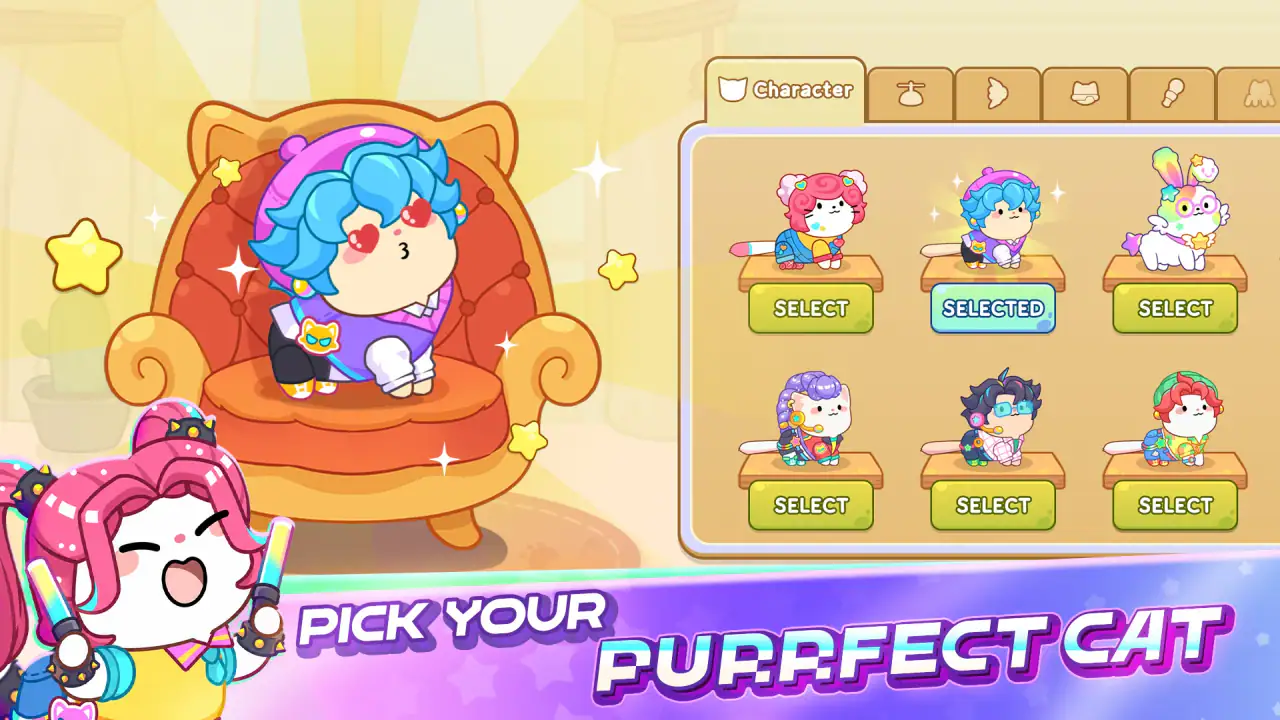
A practical tip is to begin with sound enabled and a comfortable volume. Turning audio off immediately can remove part of the timing information that gives this type of game its identity. If you are playing in a noisy place, headphones may make the rhythm easier to follow, although I would avoid treating them as essential equipment. The game should still be judged by whether its visual and audio cues work together for you.
Why the cat-and-music combination works
The cat theme gives the arcade format a friendly entry point. A serious-looking rhythm challenge can feel demanding before you even begin, whereas a cute character lowers that barrier. I found the presentation useful for making repeated attempts feel less severe. When the game asks you to try again, the tone is playful rather than intimidating, which suits casual players who want a challenge without a heavy competitive atmosphere.
The music element also gives the platforming a clearer personality. A standard bouncing game may be judged mainly by its obstacles and responsiveness. Here, the beat becomes part of the reason to keep playing. When the timing lines up, movement feels more deliberate, and a simple action can become satisfying because it lands with the sound rather than happening in isolation.
That strength comes with a trade-off. If you are not interested in rhythm at all, the musical layer may not add much value. In that case, a conventional arcade platformer with more emphasis on level design or character abilities could be a better match. Cat Dash is most convincing when the player wants both the cute theme and the timing-based feel.
Where it is strongest among arcade choices
Compared with a typical endless runner, this game has a more distinctive hook. Endless runners often focus on lane changes, collecting items, and surviving for as long as possible. Cat Dash instead presents itself around a cat, bouncing movement, and musical timing. That makes it easier to recommend to someone who wants an arcade game with a recognizable mood rather than another interchangeable score chase.
Compared with a dedicated rhythm game, it appears more approachable because the action is tied to platforming rather than only to abstract notes or lanes. That can be a welcome middle ground. You get a visual character and a world to navigate while still having a reason to pay attention to the beat. Players who find pure rhythm games too formal may enjoy this softer entry point.
Compared with a traditional platformer, the musical structure changes how I think about mistakes. In a conventional title, I might focus on jump distance, enemy patterns, or hidden routes. Here, I would also ask whether the action is being performed in time. That extra layer can make ordinary movement feel fresh, but it can also make the game less suitable for someone who wants precise platforming without musical pressure.
Small habits that make the game easier to read
One useful habit is to watch slightly ahead of the cat instead of staring only at its current position. In a bouncing or rhythm-led game, the next landing area is more important than the place you have already passed. Looking forward gives you a moment to prepare your input and reduces the feeling that every action is a last-second reaction.
I also recommend separating timing errors from visual errors. If you repeatedly fail at the same point, try one attempt with your attention on the beat and another with your attention on the route. This simple test tells you what kind of practice the game is asking for. It is a more efficient approach than changing your controls randomly after every failed run.
Another practical choice is to play in short blocks rather than forcing a long session. Rhythm and arcade games can make a player tense without noticing, especially after several near misses. A brief pause can reset your timing and prevent a cute, low-pressure game from turning into an unnecessarily frustrating one. For me, that is a better way to preserve the fun of repeated attempts.
Who should choose it and who should skip it
I think Cat Dash is a good fit for players who want a free arcade game with a light visual identity and a musical center. It is especially easy to suggest to people who enjoy cats, quick challenges, and games that can be understood in short sessions. Families may also appreciate the Everyone rating, although younger players will still benefit from an adult checking how in-app purchases are handled on the device.
I would be more cautious about recommending it to someone seeking a deep story, a large exploration map, or a complex character-building system. Nothing about its arcade focus suggests that those are the reasons to install it. Players who dislike repeating sections, timing actions to music, or concentrating on quick movement may also find that the cute presentation does not compensate for the core challenge.
It may not be the right choice for a player who wants a completely quiet game for public places. The music is central to the concept, and playing without audio could weaken the experience. In that situation, a visual puzzle game or a slower platformer may be more convenient. The better alternative is not necessarily more advanced; it may simply match the environment and your attention better.
What free really means here
The game is free to download, which makes trying it straightforward. However, the listing includes in-app purchases ranging from $0.99 to $99.99 per item. I would treat that as an important part of the decision, especially if the phone is shared with children or if you tend to make impulse purchases during a difficult arcade run.
My advice is to decide your spending boundary before playing rather than after becoming invested. A free entry point is valuable because you can test the controls and musical style without paying first, but optional purchases can change how comfortable the long-term experience feels. If you prefer games with one clear upfront cost and no purchase decisions, a paid arcade alternative may suit you better even if its initial download feels less convenient.
The cost of switching is low in one sense: you can try Cat Dash without committing money at the start, and you can remove it if the rhythm-platforming mix does not click. The larger cost is your time and attention. Before spending on anything, I would give the game enough sessions to decide whether the core movement remains enjoyable after the novelty of the cat theme wears off.
How it fits into an everyday routine
Imagine waiting for a friend who is running late. You have enough time for a focused activity but not enough for a long adventure game. Cat Dash fits that gap better than a title that needs a saved story state or a lengthy mission. I would play with the sound on, attempt a few runs, and stop after a successful improvement rather than continuing until frustration takes over.
It can also work as a short reset between demanding tasks. The music gives your attention something concrete to follow, while the arcade structure keeps the commitment small. That does not make it a productivity tool, and I would not use it when I need complete mental quiet, but it can provide a more active break than scrolling through an endless feed.
For a child, the same scenario needs more supervision around purchases and session length. The Everyone rating makes the content broadly accessible, yet accessibility does not automatically mean every setting is suitable for every family. I would introduce it as a timing game, show how to stop a run, and make sure purchase controls are appropriate before handing over the phone.
What changes your decision over time
The first few minutes answer whether the style appeals to you. The longer-term question is whether improvement feels rewarding. A good arcade game gives you a reason to replay: you understand the timing better, react more cleanly, or reach a point that previously stopped you. If each attempt feels identical and your mistakes seem random, the game will probably have a short lifespan on your device.
Version 2.0.64 is the current release, so I would install that version before judging performance or feel. Keeping the game updated is sensible for any title whose controls and timing matter, because small changes in responsiveness can affect the experience. I would also avoid comparing your first session with someone else’s polished results; rhythm games often feel awkward until your eyes and ears begin working together.
The rating of 4.8 from around 1.2 thousand ratings is encouraging, and the 500 thousand-plus install count shows that the game has reached a substantial casual audience. Still, those figures cannot tell me whether its particular rhythm suits my hands or whether the purchase model feels comfortable. I use them as a reason to try the game, not as a substitute for trying it.
My clear recommendation
I recommend Cat Dash to anyone looking for a cheerful, free arcade game that combines a cat character with music-led platforming. Its strongest quality is the way it gives a familiar quick-play format a specific identity. The game is easy to approach, suitable for an Everyone-rated audience, and well suited to short sessions where you want a small challenge rather than a large commitment.
I would skip it if your priority is deep progression, quiet play, or a platformer built entirely around precision independent of music. In those cases, a conventional platform game, a pure rhythm title, or a slower puzzle alternative may be a better choice. The decision comes down to whether the beat makes movement more enjoyable for you or simply adds another demand.
My final advice is to test it with audio enabled, play several short sessions, and pay attention to whether each attempt teaches you something. Do not judge it only by the cute cat presentation, and do not rush into an in-app purchase before you know the basic loop has lasting appeal. If music, bouncing movement, and quick arcade retries sound like a good combination, Cat Dash is easy to try and worth keeping in your shortlist. For everyone else, its focused design makes the answer equally clear: choose an alternative whose main challenge matches the way you actually like to play.
FAQs for Cat Dash: Cute Cat Music Game
What is Cat Dash: Cute Cat Music Game?
Cat Dash: Cute Cat Music Game is a casual rhythm game in which players guide an adorable cat through colorful, music-driven levels. The main challenge is to tap, swipe, or react in time with the beat while avoiding obstacles and collecting rewards. Its cute presentation and simple controls make it suitable for short gaming sessions and players who enjoy relaxed music games.
How do you play Cat Dash: Cute Cat Music Game?
Gameplay is based on timing and quick reactions. As the cat moves through each stage, you follow the rhythm of the soundtrack and interact with on-screen prompts to keep the run going. Successful actions can help you collect items, achieve higher scores, and unlock additional content. The controls are generally easy to understand, although faster songs and more complex patterns may require practice.
Is Cat Dash: Cute Cat Music Game free to download and play?
The game can generally be downloaded for free, allowing players to try its core gameplay without an upfront purchase. However, free mobile games may include optional in-app purchases, advertisements, or paid items that provide cosmetic content, extra attempts, or other conveniences. Before downloading, it is worth checking the store listing for the current pricing, advertising policy, and available purchase options.
Does Cat Dash: Cute Cat Music Game require an internet connection?
Some parts of Cat Dash may work without a constant internet connection, particularly basic gameplay that has already been installed on the device. Nevertheless, an internet connection may be needed for downloading updates, displaying advertisements, synchronizing progress, accessing online features, or making purchases. Offline availability can also vary by version, so players should test the game after installation if dependable offline play is important.
Is Cat Dash: Cute Cat Music Game suitable for children?
Cat Dash: Cute Cat Music Game uses a friendly cartoon style, cute animal characters, and straightforward rhythm gameplay, which may appeal to children and families. Parents should still review the age rating and privacy information before installation. It is also advisable to check whether the game contains advertisements, links to external content, or in-app purchases, and to enable parental controls if younger players will use the device.
Pros
- Simple one-touch controls are easy for beginners to learn.
- Cute cat visuals give the game a cheerful
- family-friendly style.
- Short levels work well for quick gaming sessions.
- Music and rhythm make ordinary obstacle dodging more engaging.
- Unlockable content gives players a reason to keep progressing.
Cons
- Gameplay may feel repetitive after extended play sessions.
- Fast sections can be difficult on smaller phone screens.
- Some content may require watching ads or making purchases.
- Limited depth may disappoint players seeking a challenging rhythm game.
- Performance can vary on older devices during busy scenes.


